


Nobel Prize in Economic Sciences, 2024
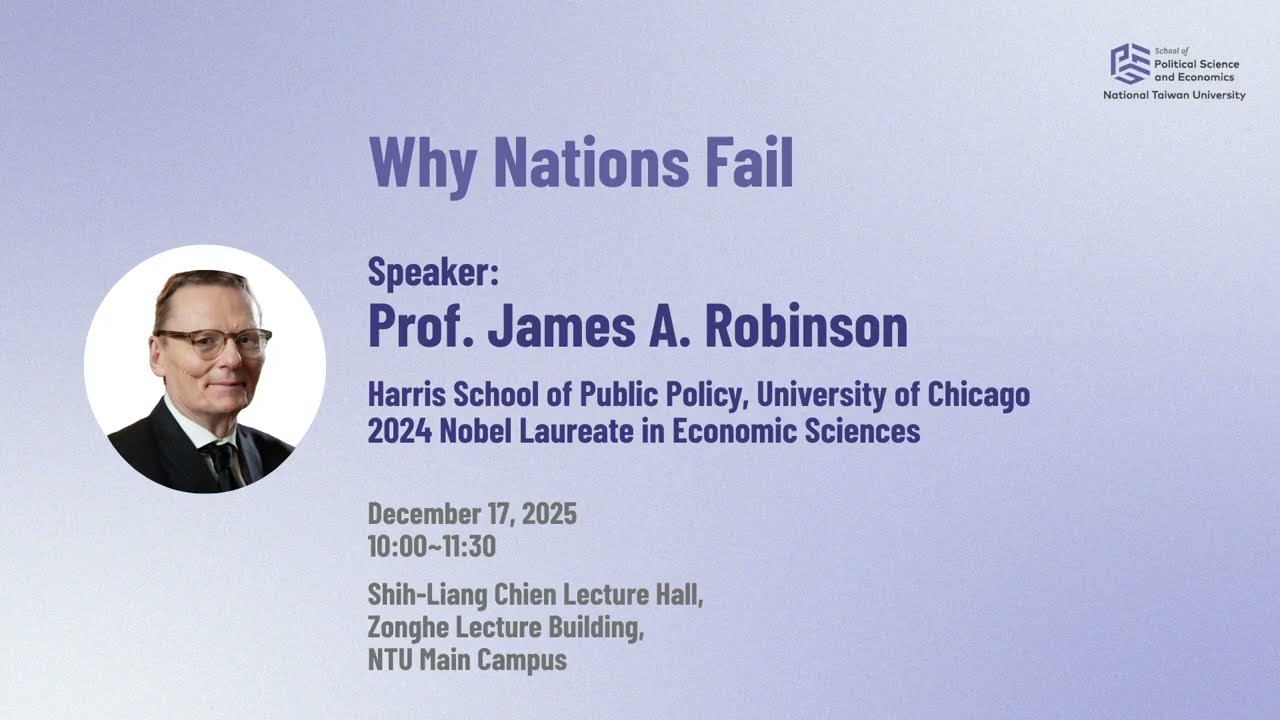
Prof. James A. Robinson
University of Chicago, USA
Health and schooling can be ranked. Culture cannot.
Searching for Fish in Trees I
· National Taiwan University · Class lecture at the NTU School of Political Science and Economics
Development economics looks at a poor country and asks what it lacks. Robinson re-sorts those lacks: what can genuinely be ranked, what is merely different, and what can be changed. The World Bank opened a cattle market in Lesotho and nobody sold a cow. Cattle there are savings, and bride wealth.
Full lecture
Two versions, side by side
Each laureate spoke twice: the formal lecture in Stockholm in the year of the award, and this one in Taiwan. Years apart, before a different audience, the account is not always the same. The pair repays watching together.
The Taiwan lecture
17 December 2025
National Taiwan University
Further up this page, ready to play.
The original Nobel Lecture
2024
Stockholm
The formal lecture from the prize year, on nobelprize.org, with video and transcript.
- One body of research; what each talk chose to include.
- From peers in Stockholm to students in Taiwan: how the telling changes.
- What has been revised between the prize year and now.
My notes
Learning area →A private notebook for this lecture. Everything you write stays in your own browser and is saved as you type. The fields follow the three stages set out in the learning area: write the question you want to ask before it (prepare), set down the argument once you have heard it (attend), then your own response and a further question (reflect).
This browser will not let the site keep anything, so what you write disappears when you leave the page. The usual causes are a private window or a setting that blocks site data. Copy anything you need first.
-
1Prepare
Before the lecture: settle on this one, watch the guide and the original Nobel Lecture, and write the question you want to ask.
Look up whatever you do not know — the official citation on nobelprize.org, the laureate’s own institution, Wikipedia. An hour of background changes what the same fifty minutes is worth.
A question for the speaker These three are the judging criteria of the Into the Nobel question competition.- Depth: it reaches the trade-offs and limits behind the work.
- Logic: the question stands up, and its premise holds.
- Originality: the answer cannot simply be looked up.
-
2Attend
While you listen or watch: note that you have seen the Taiwan lecture, and set down the argument in your own words.
The speaker’s core argument What the lecture argues — in your own words. -
3Reflect
Afterwards: your own response, and what you would still ask.
Your reflection What surprised you, what you disagree with, how it differs from the original Nobel Lecture.An extension question (at least one) Something the speaker would want to answer, and that cannot be looked up.
What you write stays in this browser and is never uploaded. It disappears if you switch machines or clear site data, so keep a copy of anything you need.
Notes are to be written by the student; how each field is written (typed, pasted or inserted automatically) is recorded alongside it and goes into the file exported from the learning area.
Watch next
-
 1 Nobel Prize in Economic Sciences, 2024 Prof. James A. Robinson He and his co-author were too materialist, he says, and underrated ideas.
-
 1 Nobel Prize in Economic Sciences, 2024 Prof. James A. Robinson The same trait can rank opposite ways in two societies.
-
 1 Nobel Prize in Physics, 2018 Prof. Gérard Mourou A laser pulse had to be stretched before it could be amplified.